What the Ping Test Can and Cannot Do
26 September 2026 · about 7 minutes
Ping test review, technical report, 26 Sep 2026 (PDF)This site has offered a ping test since February: tap a coin, let the phone hear the ring, and compare it with a reference frequency. A review of that work found that the method and its reference values do not support the confidence the site gave them. This note corrects the record, and sets out what a phone can measure properly.
How a coin rings
A struck coin vibrates as a thin free disc. It has several bending modes, each with its own frequency. The lowest is labelled (0,2), and above it come (1,0), (0,3), (1,1) and (0,4). Plate theory gives each frequency as
So the ring is set by the metal's stiffness (E), density (ρ) and Poisson's ratio (ν), and by the coin's thickness (h) and radius (a). The modes are not harmonics: their frequencies sit at about 1.75, 2.27, 3.7 and 3.9 times the lowest.
The correction: what the old method got wrong
The old method used one number per coin, the (0,2) frequency, and passed a coin if the phone's loudest nearby peak was within ±3% of it. The review found the following.
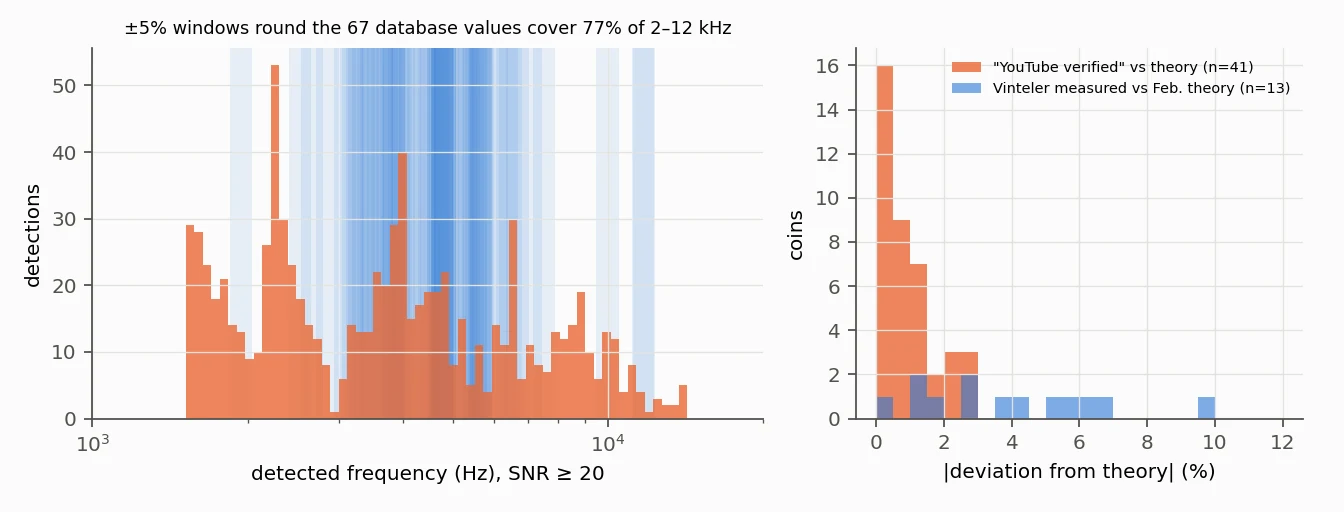
- Where the 67 reference values came from. 14 came from two published papers (Vinteler 2025 and Manas 2015). 46 were marked “YouTube verified”, and 7 were theory. None was measured by us.
- The YouTube verification proved nothing. A tone heard in a video was accepted if it lay within 5% of any coin's theoretical value. Those windows covered 77% of the 2–12 kHz band, so almost any tone passed, and the “verified” values were the theory echoed back.
- The real error is several per cent. Against the only independent measurements, the best earlier model was 4.7% rms (up to 9.9%), and that was on the very coins its constants were tuned to. A model from handbook values does about the same, 4.0% rms. Real coins of one type also differ from each other, so a theory value cannot support a ±3% gate. A genuine gold Maple whose lowest mode splits into 4,590 and 5,060 Hz fails that gate on both peaks.
- The old report's headline claims do not hold. Its “0.90% mean error” was circular, because agreement with the theory was the rule for accepting a value. Its “zero mismatches” checked coin names, not frequencies.
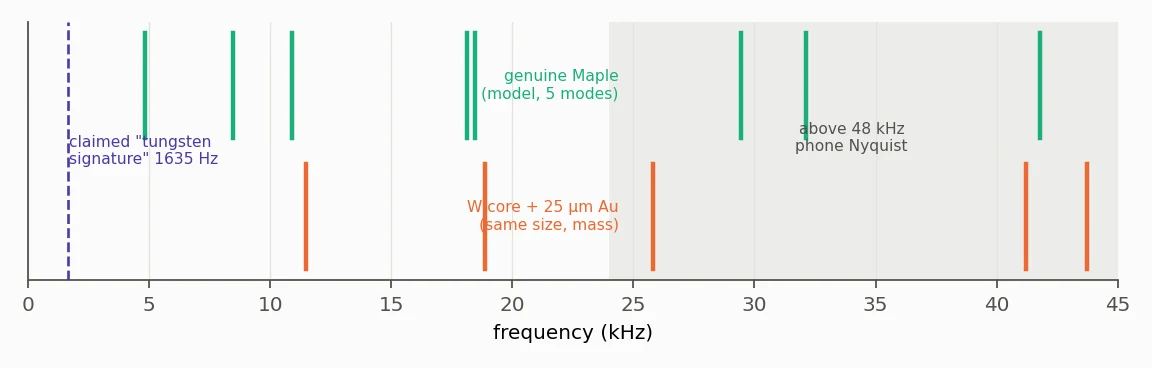
- The “counterfeit signatures” were not ring tones. The four tones at 1.5–2.1 kHz came from narration and noise in the videos. In one, the narrator says the fake “makes absolutely zero sound”. Physics predicts the opposite of what was claimed: a tungsten-cored Maple should ring about 2.4 times higher than a genuine one, not lower.
In short, a single-frequency match against a theory value is weak evidence on its own, and the site should not have presented it as more.
What a phone can do now
A phone recording at 48 kHz can hear three to five modes of a bullion coin: all five for 1 oz coins, three for a 1/10 oz coin or a Sovereign. In simulation it measures each frequency to about 0.001%, far finer than the differences between genuine coins, so the phone is not the limit.
The useful quantity is the ratio between modes. Ratios cancel the coin's size, thickness and overall stiffness, and one ping gives the Poisson's ratio of the metal to about ±0.007. Together with the coin's weight and size, it tells you the stiffness per unit mass. It does not measure density; the scale and callipers do that.
The measurement uses classical signal processing: a coin's ring is a handful of decaying tones at roughly known frequencies, a textbook problem. Machine learning helps around it, for example by rejecting double taps or speech, but not as the measurement itself.
Ping, pendulum, weight and size together (modelled)
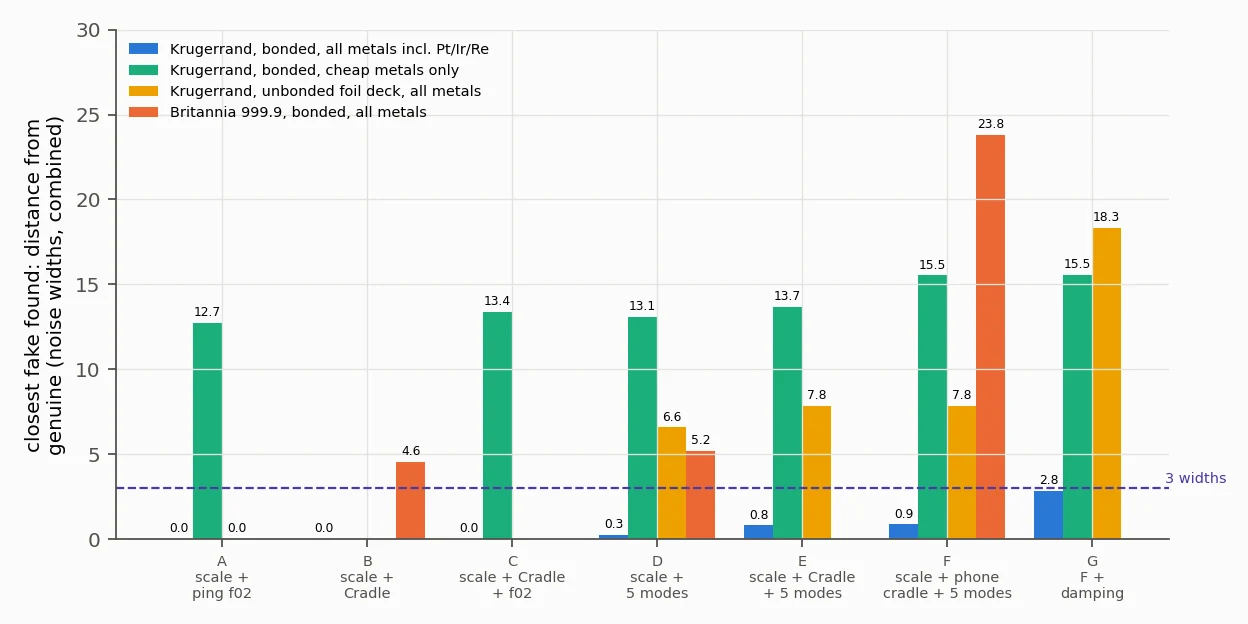
The ping and the eddy-current pendulum measure different physics: bending stiffness against electrical conductance. The scale fixes the mass. A fake built to fool one of them pays for it on another. The review searched thousands of layered constructions for the fake that comes closest to a genuine coin on every channel at once, measured in noise widths (a distance of 3 or more is a clear difference).
- Affordable metals. With weight, the phone-read pendulum and five ping modes, no fake built from affordable metals comes within 11 noise widths of a genuine Krugerrand (15.5 for bonded stacks, 11.0 for a loose foil deck). The tantalum–tungsten stacks that can fool the pendulum on 22 ct coins ring about 10% high, so the ping catches them.
- Fine gold. Nothing comes within 19 noise widths of a genuine Britannia.
- The exception. A bonded stack of a 22 ct skin, lead, zinc and a platinum core can match every channel, to within 0.9 widths (2.8 once damping is counted). It needs about 58% platinum by mass and five bonded layers at 0.1 mm tolerances, so it is costly and hard to make. Catching it would need a test that sees through the thickness.
What happens next
- Record genuine coins: ten Krugerrands and ten Britannias, five taps each on one phone. That measures the one number everything above leans on, how much the mode ratios vary between genuine coins.
- Record a real fake, starting with a gold-plated tungsten Eagle. The physics predicts it rings far higher than genuine.
- Until then, the ping tester on this site stays a free tool with its reference values labelled as theory, and the ping result is recorded on reports but not scored.