A 3D-printable pendulum gold tester that your phone reads. The phone films the swing, and the app measures how strongly the coin brakes the magnet.
Status: in development — prototype testing under way; files and app will be released after testing. Every performance figure on this page is modelled, from a physics simulation. None has yet been measured on a printed unit.
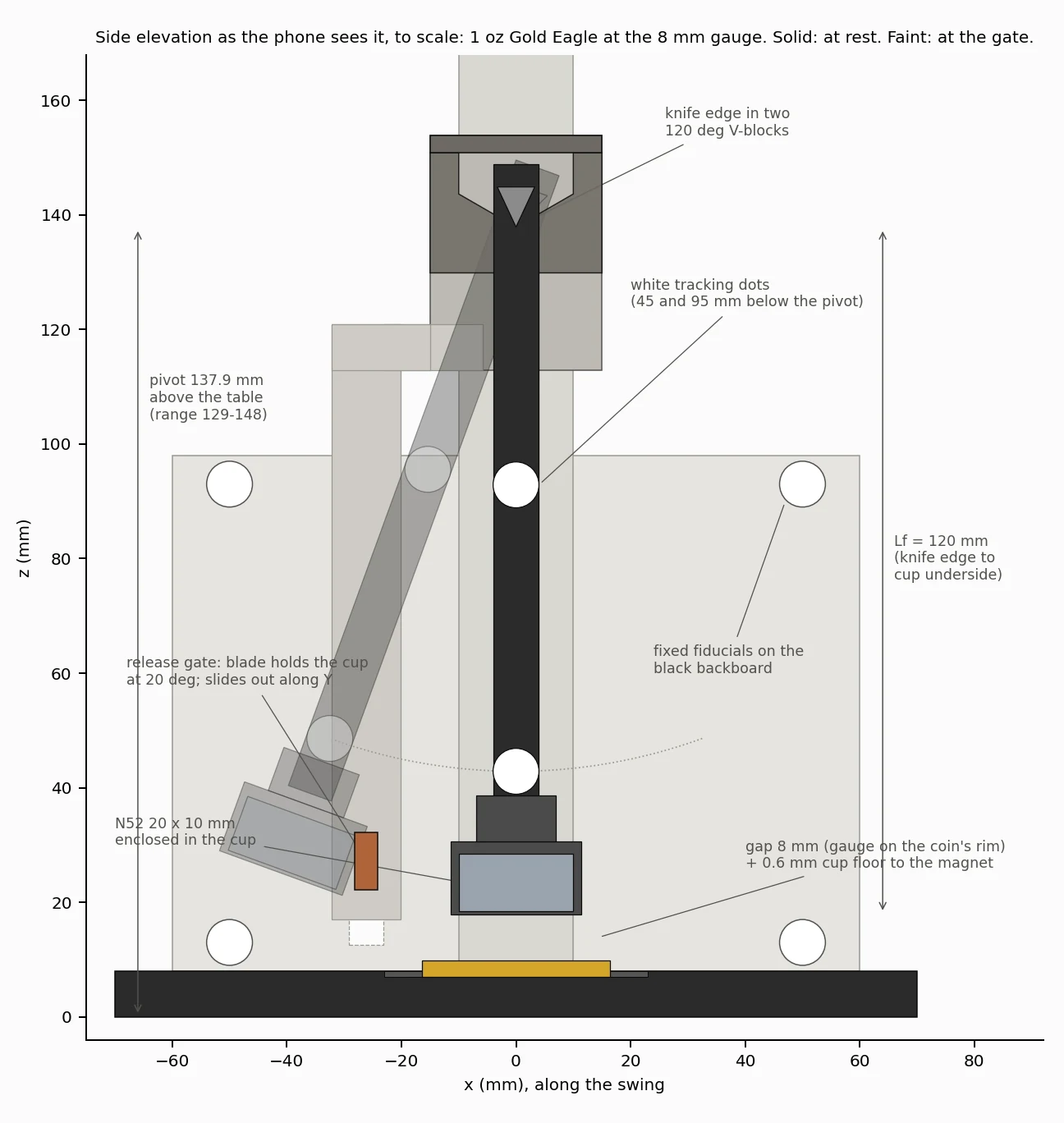
Side view, to scale, as the phone sees it. Schematic drawing from the design; not a photo.
How it works
1
A pendulum swings over the coin
A printed pendulum hangs from a printed knife edge. Its bob is a cup that fully encloses one disc magnet. As the magnet passes over the coin, it induces eddy currents in the metal, which brake the swing. How strongly depends on the coin's electrical conductivity and thickness. A printed gauge sets the gap from the coin's rim, and a printed gate releases the bob from the same angle each time.
2
The phone films the swing
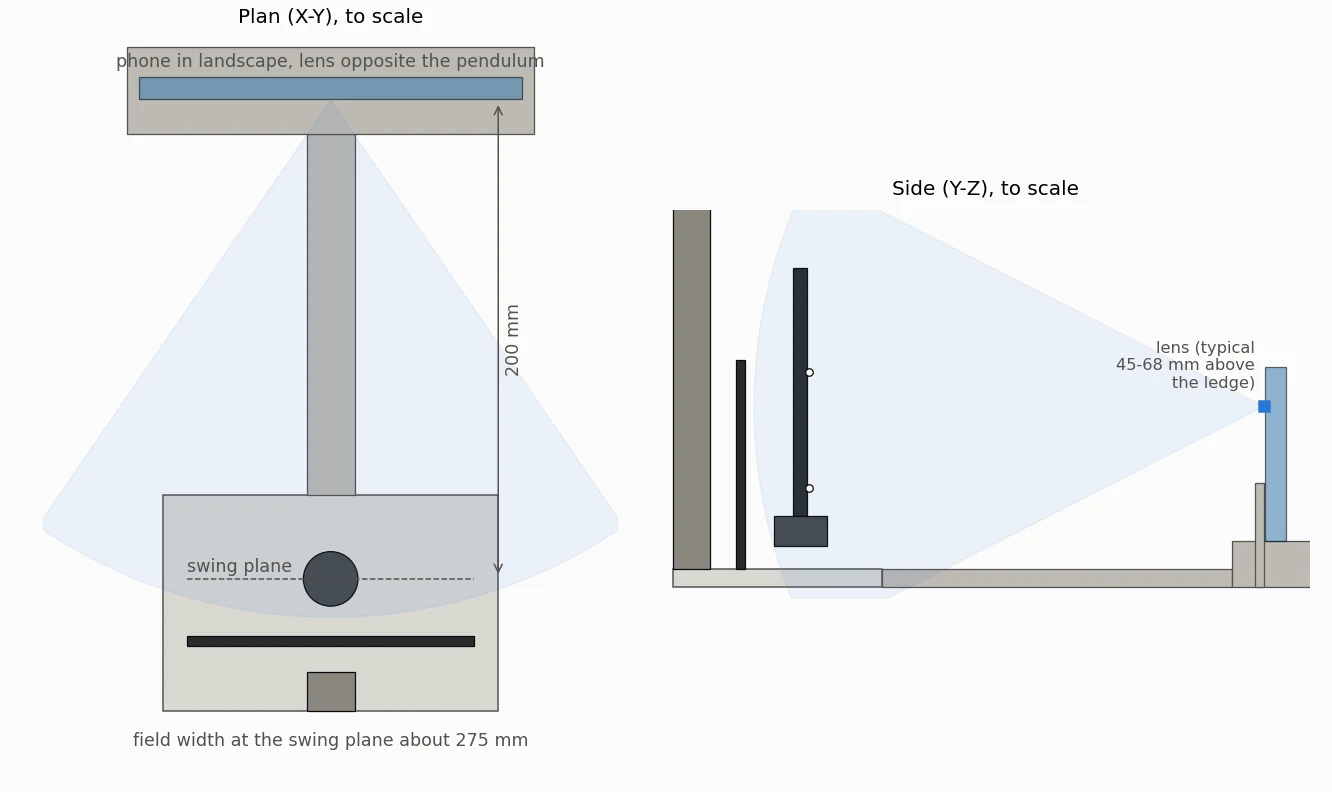
The phone stands about 200 mm away. It tracks two white dots on the black arm and four fixed dots on a black backboard. The fixed dots correct for the phone's position and tilt, so the stand does not need to be exact. From the dots the app gets the arm's angle in every frame.
3
The app fits the decay
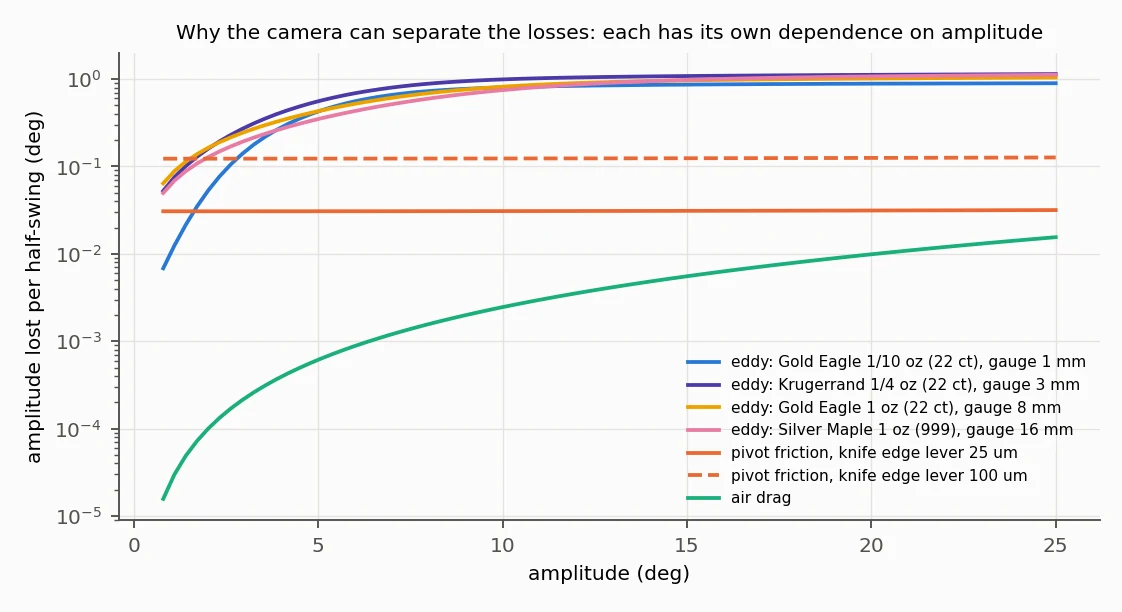
Two things slow the pendulum: the coin's braking, and friction at the pivot. At large swings both take off a similar angle per swing. In the last few degrees they differ: friction keeps taking the same amount, while the coin's braking fades. The app fits the shape of the whole decay and separates the two. The result is the coin's braking on its own, with an uncertainty, rather than a count mixed with friction.
Modelled. Angle lost per half-swing: the coin's braking (curves) falls away below about 10°, pivot friction (flat lines) does not. That difference is what lets the fit separate them.
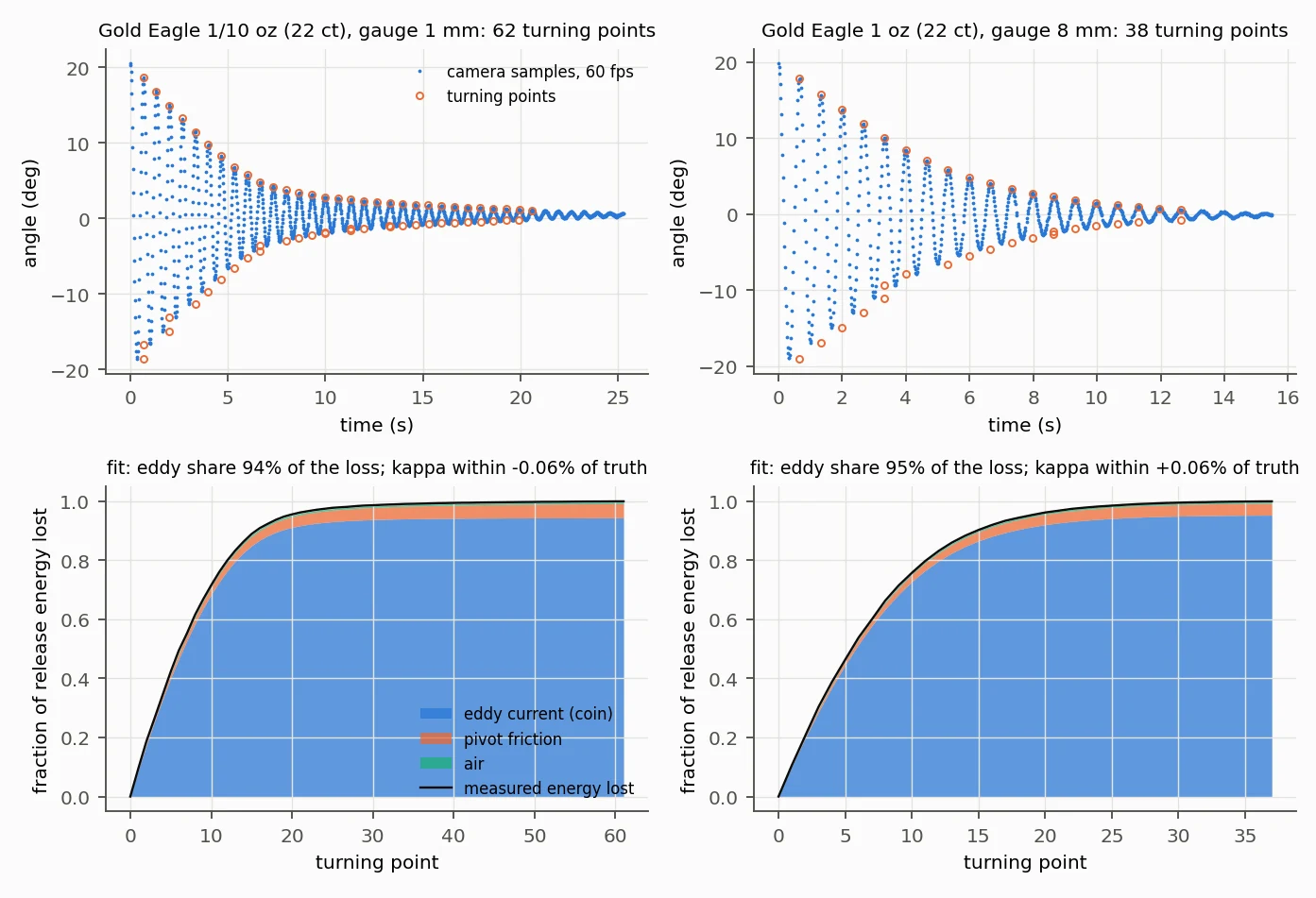
Modelled. Top: simulated camera samples at 60 fps for two Gold Eagle coins. Bottom: the fitted share of the energy lost to the coin, the pivot and the air.
What you need
A 3D printer
Every part is printed in PLA. Designed to fit a 180 mm bed. Estimated at about 280 g of filament and 15 hours of printing.
One magnet
An N52 neodymium disc, 20 × 10 mm, magnetised through its thickness. It is the only part you buy, and it is fully enclosed in the printed cup.
A phone
A phone with a camera. The app is planned to run in the browser; 30 frames per second is modelled as enough.
Recommended: a genuine coin of the same type as the one you are testing, measured in the same session. Comparing against it removes most of the error from the gap setting and the magnet's strength.
Where the phone goes: in landscape, about 200 mm from the swing. Schematic drawing, to scale.
Modelled performance
Modelled — not yet measured
Scatter of the result between releases
0.1–0.2%
Simulated camera at 60 fps, eight coin types.
Change in the result when pivot friction changes sixteen-fold
0.2% or less
A dial or swing count on the same pendulum moves by 5–34%.
Largest tracking noise the fit tolerates
0.2° per frame
Above this the result is biased. The dot tracker is designed for about 0.05°.
Effect of a 0.1 mm error in the gap
3–5%
Why a genuine reference coin of the same type is recommended.
All figures come from a physics simulation of the printed pendulum and a simulated phone camera. They will be replaced by measurements once the prototypes are tested.
What it cannot do
It measures electrical conductivity and thickness, not weight or size. Weigh and measure the coin as well.
A fake built to match a coin's conductivity exactly cannot be caught by this or any other eddy-current test. The ping test and the weight and dimension checks remain part of the workflow.
For 22 ct coins, a carefully engineered layered fake can read close to genuine. Testing both faces of the coin helps when the layers are not symmetric.
Dim light or a wobbling stand can spoil the tracking. The app is designed to reject a run it cannot measure, and say why.
The prototype
Photo coming — prototype arriving
The printed Phone Cradle: tower, pendulum and backboard
The printed Phone Cradle (prototype)
Photo coming — prototype arriving
A phone in its stand filming the Phone Cradle pendulum
Phone in position, filming the swing (prototype)
Measured on the Phone Cradle prototype
Awaiting prototype
Ten releases per coin, both faces, re-seating the coin each time. Scatter is the spread of the fitted braking coefficient between releases.
Coin
Sample
Modelled scatter
Measured scatter
Result
Gold Eagle 1/10 oz (22 ct)
Genuine
0.13%
—
not yet measured
Gold Eagle 1 oz (22 ct)
Genuine
0.19%
—
not yet measured
Kangaroo 1 oz (999.9)
Genuine
0.17%
—
not yet measured
Silver Maple Leaf 1 oz
Genuine
0.19%
—
not yet measured
Gold Eagle 1 oz
Gold-plated tungsten fake
separated (modelled)
—
not yet measured
Results coming — prototype testing under way. Nothing in this table has been measured yet.
Magnet safety. An N52 magnet of this size is strong. Keep it enclosed in its cup and away from children, pacemakers, cards and steel tools.
Hear when it is ready
The Phone Cradle uses the same list as the pendulum kit. Join it and we will email you the test results, and when the files and app are released. There is no charge.